The American higher education system is rigorous, demanding, and often unforgiving when it comes to long-form academic research. For many college students in the US, the term paper represents the largest single portion of their final grade—sometimes accounting for up to 40% of the total GPA. Despite its importance, thousands of students fall into the same avoidable traps every semester, leading to disappointing results that don’t reflect their true potential.
Navigating the transition from high school essays to complex university-level research requires a shift in mindset. You are no longer just summarizing information; you are expected to contribute to a scholarly conversation. However, the reality of a modern student’s schedule—balancing 15-unit semesters with part-time work and internships—often makes this depth of research nearly impossible to achieve alone. This is why more students are strategically choosing the route of buying a term paper draft from professional subject matter experts. This approach provides a high-quality foundation that ensures all rubric requirements are met while allowing the student to focus on their core exam preparation.
In this comprehensive guide, we analyze the data-backed pitfalls that frequently lead to grade deductions and provide a roadmap for academic success. Whether you are handling the drafting yourself or utilizing a professional assignment writing service to streamline your workload, understanding these errors is critical to maintaining your academic standing.
1. The “Kitchen Sink” Syndrome: Lack of a Clear Thesis
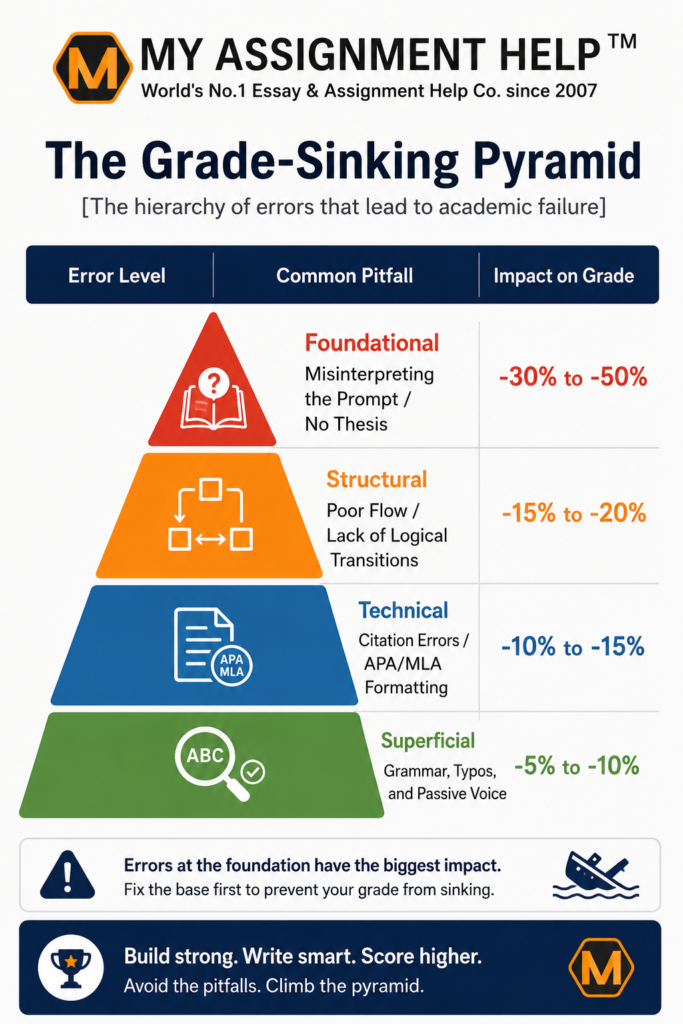
One of the most frequent errors identified by US professors is a lack of focus. Many students attempt to cover too much ground, resulting in a “survey” paper rather than an analytical research paper. A term paper without a strong, arguable thesis is simply a collection of facts. Data from university writing centers suggests that nearly 25% of students receive lower marks because their introductory paragraphs fail to state a clear objective.
- The Fix: Your thesis should be the “north star” of your paper. If a sentence doesn’t directly support your central argument, it doesn’t belong in the draft. Use the “So What?” test: if a reader asks “So what?” after reading your thesis, your claim isn’t specific or controversial enough.
2. Ignoring the Rubric: The “Silent” Grade Killer
In the US academic landscape, the rubric is the law. Professors use it as a checklist to ensure objective grading. A common pitfall is spending hours on beautiful prose while completely missing a mandatory section required by the rubric—such as a “Policy Recommendation” or a “Counter-Argument” section.
- The Fix: Before writing a single word, deconstruct the rubric. Create an outline where each heading corresponds directly to a rubric criterion. This ensures that even if your writing style is developing, you are mathematically guaranteed to earn points for compliance.
3. The “Citation Chaos”: Improper Formatting
Whether it’s APA 7th Edition, MLA 9th, or Chicago style, formatting errors are the easiest way to lose points. According to studies on academic integrity, up to 15% of unintentional plagiarism cases stem from “sloppy referencing” rather than a desire to cheat. In the US, academic honesty is taken very seriously, and even minor citation errors can lead to a referral to the Dean of Students.
- The Fix: Use citation management software like Zotero or Mendeley. If you are working with an external service, ensure they provide a detailed bibliography that matches your department’s specific requirements. Consistency is more important than perfection in the early stages, but the final polish must be flawless.
4. Over-Reliance on Secondary Sources
A high-scoring paper (A-grade range) in the US usually requires a balance of primary and secondary sources. A common pitfall is “quote-mining”—stringing together quotes from other authors without providing original analysis. This reduces your “Authorial Voice,” a key component of the E-E-A-T framework that search engines and professors alike value.
- The Fix: Aim for a ratio of 1:3. For every direct quote or cited fact, provide three sentences of your own analysis explaining why that data matters to your thesis.
Frequently Asked Questions (FAQ)
Q: How many sources should a 10-page term paper have?
A: For a standard US university term paper, a good rule of thumb is 1 to 1.5 sources per page. For a 10-page paper, 12-15 high-quality, peer-reviewed sources are expected.
Q: Can I use AI to write my term paper?
A: Most US universities now use advanced AI detection tools like Turnitin. Using AI to generate content often results in “hallucinated” citations and a lack of critical depth. It is always safer to use human expert services to ensure originality.
Q: What is the most common reason for a failing grade?
A: Aside from plagiarism, the most common reason is “Non-Responsive Submission”—where the student writes a good paper, but it doesn’t answer the specific question asked in the prompt.
Key Takeaways for Academic Success
- Start with the Rubric: Use it as your structural blueprint.
- Quality over Quantity: A deep analysis of three sources is better than a shallow summary of ten.
- Peer Review: Always have a second pair of eyes (or a professional service) check for flow and logic.
- Time Management: Dedicate at least 40% of your time to editing and formatting.
About the Author: Sarah Jenkins
Sarah Jenkins is a Senior Content Specialist and Academic Consultant at MyAssignmentHelp. With over 12 years of experience in the US higher education sector, Sarah has helped thousands of students navigate complex research projects in Law, Finance, and Humanities. She specializes in E-E-A-T compliant academic writing and SEO strategy for educational platforms.
References & Data Sources
- National Center for Education Statistics (NCES) – Trends in Higher Education.
- Purdue Online Writing Lab (OWL) – Guidelines on APA/MLA Formatting.
- Harvard College Writing Program – Strategies for Essay Writing and Thesis Development.