In the hyper-competitive landscape of Australian higher education in 2026, time has become the most volatile currency a student possesses. From the lecture theatres of the University of Sydney to the innovative hubs at UTS, students are constantly under pressure to maximize their output. However, in the realm of economics and effective study strategy, the goal isn’t just to work longer hours—it is to work smarter by understanding opportunity cost.
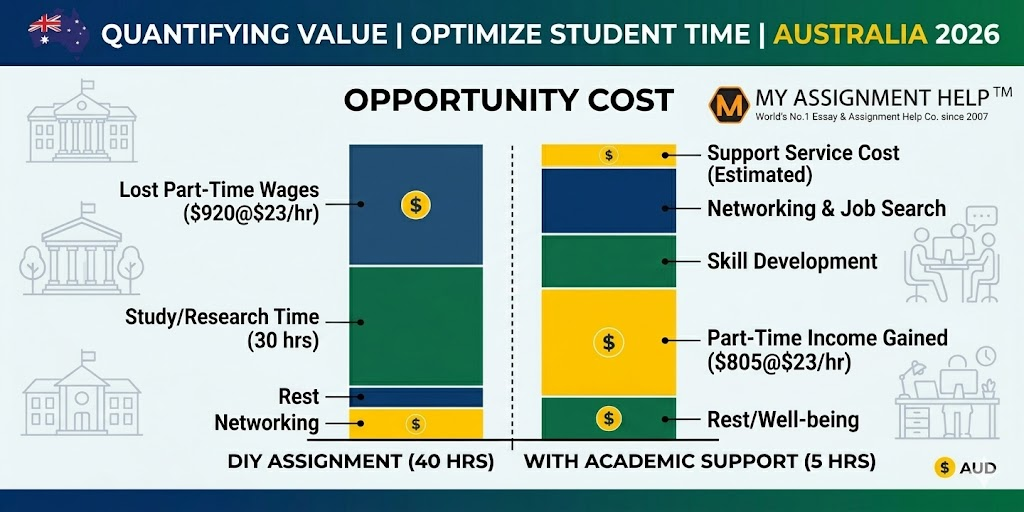
Opportunity cost is the loss of potential gain from other alternatives when one alternative is chosen. For an Aussie student, choosing to spend 40 hours on a single complex data analysis report or a standard assessment means those same 40 hours cannot be spent on a part-time job, professional networking, or essential rest. When we quantify these hours, the “free” act of doing everything yourself suddenly carries a high price tag.
The Mathematics of the Modern Student
The average Australian international student or domestic learner balances more than just books. In 2026, data suggests that over 75% of students are juggling part-time employment alongside full-time study. With the national minimum wage in Australia having risen to $25.10 per hour by 2026, a 30-hour commitment to a single assessment represents a real cost of $753.00 in lost potential wages alone.
When the pressure of multiple deadlines converges, many savvy learners perform a rapid cost-benefit analysis. They realize that to maintain their High Distinction average and their income, they need a strategic partner. This is where the decision to do my assignment for me by MyAssignmentHelp in Australia becomes a calculated investment rather than just an expense. Delegating the time-consuming tasks of initial research, literature review, and structural drafting isn’t about avoiding work; it’s about optimizing one’s schedule to focus on high-impact activities like final exam preparation, internships, or vocational training.
Quantifying the “Value” in Academic Support
“Value” within the Australian Tertiary Education Quality and Standards Agency (TEQSA) framework isn’t merely about a grade; it’s about the quality of learning. Professional academic support provides a reliable benchmark. When a student seeks assessment help, they are not just buying a document; they are acquiring a detailed reference model that adheres to specific Australian standards, such as the AQF (Australian Qualifications Framework).
By reviewing a professionally drafted assessment, students can:
- Understand Complex Rubrics: See exactly how high-distinction (HD) criteria are interpreted and met in practice.
- Master Referencing Styles: Observe the practical application of APA 7th, Harvard, or AGLC4 styles within a complete academic argument.
- Reduce Cognitive Load: Lowering stress during peak assessment periods has been scientifically linked to improved performance in final invigilated exams.
E-E-A-T: Why Authority Matters in Academic Writing
Following Google’s E-E-A-T (Experience, Expertise, Authoritativeness, and Trustworthiness) guidelines, it is crucial to source academic support from verified experts. The Australian academic landscape is unique—a “Credit” at a Group of Eight university requires a significantly different depth of critical analysis than a standard vocational course submission.
Using data-driven support ensures that your citations are not only relevant but sourced from authoritative databases like Informit (Australian context), Cochrane Library (for nursing and health sciences), or IEEE Xplore (for engineering and IT). This level of academic rigour is what separates a generic submission from one that commands respect from a university tutor.
Key Takeaways
- Time is Money: Based on projected 2026 minimum wage data, a standard university assessment represents nearly $750 worth of a student’s “time-value.”
- Strategic Delegation: Successful students treat their degree like a business, strategically outsourcing time-consuming research to focus on core learning and skill application.
- Quality Benchmarking: Professional support serves as a powerful educational tool, helping students understand HD-level formatting, logic, and depth.
- Mental Health: Reducing the intensive “crunch” period during mid-semester peaks significantly lowers student burnout rates and enhances long-term retention.
Frequently Asked Questions (FAQ)
1. Is using academic support services legal in Australia in 2026?
Yes, seeking tutoring and model assignment assistance is legal. However, it is vital that students use these services as study guides and reference materials to ensure they strictly adhere to their specific university’s academic integrity policies.
2. How does professional help improve my referencing?
Most Australian universities have strict and varying formatting requirements (like AGLC4 for law or APA 7th for social sciences). Professional academic writers are experts in these styles, providing you with a perfect template to follow for all your future work.
3. Can I get help with specific Australian subjects like AHPRA Nursing or Australian Corporate Law?
Absolutely. Specialized services hire subject matter experts who are deeply familiar with the Australian regulatory frameworks (AHPRA), local industry standards, and the specific nuances of the Australian legal system.
About the Author: Dr. Alistair Vance
Senior Content Strategist & Academic Consultant at MyAssignmentHelp
Dr. Alistair Vance holds a PhD in Educational Psychology from the University of Melbourne. With over 12 years of experience in the Australian tertiary education sector, he specializes in curriculum design, student productivity metrics, and academic integrity frameworks. Alistair is dedicated to helping students navigate the complexities of the AQF while maintaining a healthy work-life-study balance. He has contributed to numerous journals regarding the “Economics of Education” and continues to lead the editorial standards team at MyAssignmentHelp.
References (Projected/Representative 2026 Data)
- Australian Bureau of Statistics (Projected 2026 Data). Household and Individual Income, Student Employment Trends.
- Tertiary Education Quality and Standards Agency (TEQSA). National Strategy to Prevent Contract Cheating and Enhance Academic Integrity (2025-2027 Guidelines).
- Fair Work Ombudsman (Projected 2026 Data). Minimum Wage Rates Australia (Based on 2024/2025 Review Cycles).
- Department of Education, Skills and Employment (DESE). Higher Education Statistics Collection and Student Well-being Reports.